

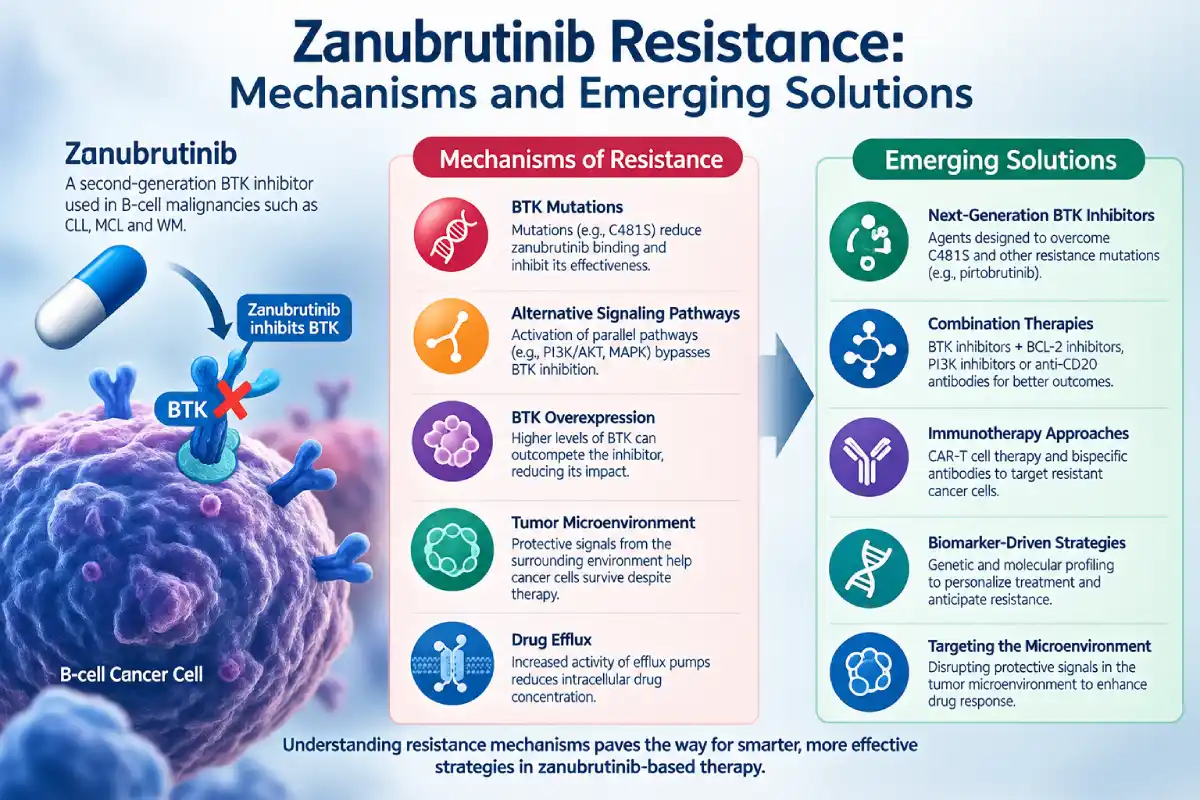
Zanubrutinib is a second generation covalent BTK inhibitor used for the treatment of several B-cell malignancies. Zanubrutinib is a BTK inhibitor that blocks the B-cell receptor signaling pathway which is necessary for the survival of malignant B-cells. CLL patients with malignant B-cells have shown durable clinical responses to treatment with Zanubrutinib; however, there remain significant clinical challenges associated with resistance to covalent BTK inhibitors, and a number of genetic and distinct molecular and clinical correlated modes of resistance have been described and continue to be under investigation for the development of novel therapeutic approaches.
Table of Contents
Understanding How Zanubrutinib Works
The BTK enzyme is part of the B-cell receptor (BCR) signaling pathway of malignant B cells. Inhibiting this enzyme leads to disrupted survival signals for malignant B cells resulting in inhibition of malignant cell proliferation and or death. Zanubrutinib acts as a covalent BTK inhibitor, specifically binding on the C481 site of the BTK enzyme.
Selectivity does not necessarily translate to irreversibility of inhibition, however. The number of kinases inhibited at higher concentration by Zanubrutinib in comparison to ibrutinib or acalabrutinib provides valuable insight into the potential for the emergence of resistant cells during therapy.
BTK Mutations and Covalent Binding Resistance
C481 mutations affect the BTK binding site. Inhibitors of the covalent BTK inhibitors class (ibrutinib, acalabrutinib and Zanubrutinib) bind to the C481 residue of BTK, to provide sustained inhibition of the enzyme. Mutations in the BTK binding site, particularly a C481S mutation, interfere with the covalent interaction between the inhibitor and BTK.
In order for covalent binding to take place at the BTK active site C481 must be present in its unmodified form. A C481 mutation, most frequently C481S, can interfere with the covalent binding of BTK inhibitors to the drug-bound cysteine. It is predicted that altered protein conformations as a result of mutations at C481 and elsewhere within the BTK active site will impede the tight, long-lived inhibition of BTK achieved by covalent inhibitors such as acalabrutinib, ibrutinib, and Zanubrutinib. BTK mutations and PLCG2 alterations are the principal molecular mechanisms of resistance to covalent BTK inhibitors.
Resistance to covalent BTK inhibitors is not caused by a single mutation but rather requires additional changes within BTK or within other downstream signaling pathways, leading to complex resistant disease.
The Role of PLCG2 and Alternative Signaling
BTK is part of a signaling complex within the B-cell receptor signaling pathway. It has downstream effectors such as PLCG2 which are necessary for BCR signaling to mediate effects on B cells that are under the influence of the BCR. Mutations in these genes, such as PLCG2 mutations, can also block effects of BTK inhibition and provide resistance to BTK inhibitors.
Therefore, alternative BTK-inhibitors of different binding mechanisms might not fully alleviate resistance if other targets and downstream signaling pathways are affected by the same mutation or by the tumor’s microenvironment. Therefore, it is essential to have a deep understanding of resistance mechanisms and to switch to alternative therapeutic concepts instead of just switching between covalent BTK-inhibitors of different chemical structures.
Non-Covalent BTK Inhibitors as an Emerging Approach
Rather than targeting the covalent binding site, non-covalent BTK inhibitors are being developed to avoid resistance at the BTK binding site. The non-covalent BTK inhibitor Pirtobrutinib binds to BTK differently than the covalent inhibitors such as Zanubrutinib.
Pirtobrutinib is a non-covalent inhibitor of BTK that has been shown to be active in patients with BTK C481 variants who have been previously treated with covalent BTK inhibitors in clinical studies.
However, even non-covalent, so-called “Active-Site-inhibitors” such as pirtobrutinib are not resistant to mutations such as gatekeeper- or other kinãse-domain-mutations (e.g. H368Y/R) leading to resistance to these agents as well. Instead, continued development of next-generation BTK-inhibitors capable of targeting an increasing number of resistance-associated BTK-mutations is currently pursued.
BTK Degradation and Next-Generation Strategies
There is growing interest in strategies to ablate BTK rather than simply being an enzymatic inhibitor. Targeted protein degradation has emerged as a promising therapeutic strategy, and a number of proteolysis-targeting chimeras (PROTACs) are being investigated to degrade BTK using the cell’s protein degradation machinery.
Since active-site inhibition may not effectively be stalled at several mutated BTK sites, targeted protein degradation is an alternative approach to pharmacological stall activity of BTK. BTK degradation using proteolysis-targeting chimeras (PROTACs) is an area of ongoing research to understand its potential role in the clinic.
Many of the newer investigational BTK kinase inhibitors are designed to be active against a broad spectrum of mutant BTK proteins including the BTK C481S variant. In early research studies, for example, the BTK kinase inhibitor demonstrated potent inhibitory activity against BTK C481S as well as other BTK mutations that confer resistance to currently approved BTK inhibitors.
Combination Treatment Strategies
These alternative pathways may allow CLL cells to continue to survive even in the presence of BTK inhibition. Thus, BTK inhibitors are typically given in combination with other agents to address these resistance mechanisms.
In addition to exploiting novel modes of BTK inhibition to counteract targeted resistance mutations, a growing body of evidence supports the use of combination treatment strategies to target the numerous alternative survival pathways, which collaborate to enable CLL cells to resist the effects of single-agent BTK inhibitors.
Monitoring Resistance and Treatment Planning
Whether a patient is experiencing resistance to a cancer therapy will depend upon a number of factors including the particular cancer or lymphoma from which the patient is suffering, previous therapy given to the patient and its failure, the current clinical and laboratory status of the patient’s disease, and other clinically relevant factors.
By obtaining a molecular analysis of the patient’s malignancy, the potential resistance to particular treatments can be determined, particularly in CLL cases with BTK or PLCG2 alterations. Furthermore, treatment of patients with resistance to covalent BTK inhibitors needs to be individualized and not be restricted to other covalent BTK inhibitors.
Future Directions
With BTK being a clinically targeted entity, there is much interest in developing next-generation therapeutics designed to tackle cancer resistance to current BTK inhibitors. These can include non-covalent BTK inhibitors, as well as mutant-selective and pan-mutant BTK inhibitors; moreover, the use of BTK degraders as well as combinations targeting multiple signaling pathways are all under active investigation.
Developing more BTK inhibitors is not enough to address resistance to BTK inhibitors. In order to manage resistant cancers, we need to develop novel cancer therapies that are able to tackle a variety of resistance mechanisms.
Conclusion
Resistance to Zanubrutinib forms in various ways including changes in BTK itself as well as alterations to downstream molecules like PLCG2 and alternative survival pathways including the tumor microenvironment.
Future research is required to address and develop new therapeutic options for patients with CLL that have become resistant to covalent BTK inhibitors. To achieve long-term remission and effective cancer treatment for patients, new non-covalent BTK inhibitors, next generation of mutant-selective or pan-mutant BTK inhibitors, and other therapeutic strategies that target BTK for degradation, as well as combination therapies, are currently under investigation.
Disclaimer: The information provided in this article is intended for educational purposes only and should not be interpreted as medical advice, a clinical guideline, or a recommendation for any specific treatment.